
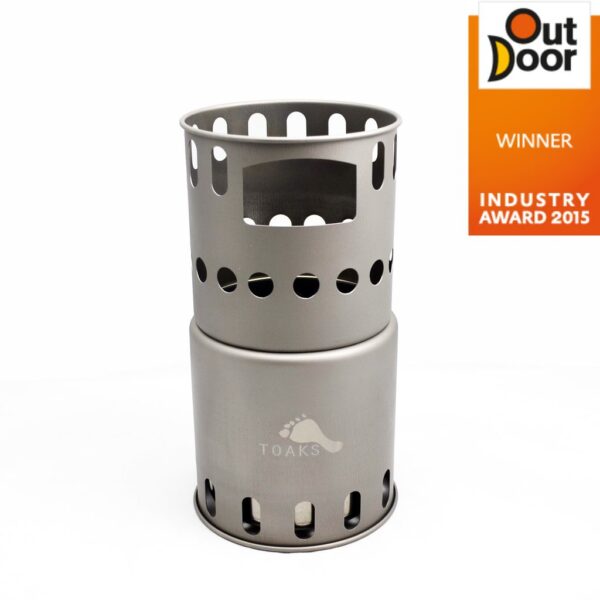


Do you want to stop depending on gas canisters or alcohol? Then the TOAKS wood burning stove is worth a look. It runs on the wood you find around you: small twigs, split sticks and pine cones all burn well in it. At 225 grams it is also a very light stove for what it does.
You assemble the TOAKS stove by sliding the parts into each other, which creates a kind of chimney that takes fairly long sticks. There is no feeding door like on the Vargo Hexagon, but there is a small opening at the top for adding fuel. The stove works as a wood gasifier: it burns the wood gas rather than just the wood, which gives a much more complete combustion and a hotter flame to cook on.
Two sizes: Normal and Small
The TOAKS wood stove comes in a Normal size and a compact Small version. The top of the Normal stove is 98 mm wide, so if you use smaller pots (like the TOAKS 750 ml titanium pot) you also need the extra cross bars. The Small version has a diameter of 88 mm and a 750 ml pot sits right on top. The nice thing is that the Small version also packs inside a 750 ml pot. On long burns the Small tends to smother a little sooner than the Normal version, so if you cook for more than one person the Normal is the better choice.
Specifications TOAKS titanium wood burning stove
- Material: titanium
- Weight Normal: 225 g
- Weight Small: 151 g
- Dimensions Normal, packed: 105 mm (diameter) x 105 mm (height), assembled: 205 mm (height)
- Dimensions Small, packed: 94 mm (diameter) x 94 mm (height), assembled: 183 mm (height)
- Origin: China
Notes
- The TOAKS titanium wood burning stove won an Outdoor Industry Award in Friedrichshafen for being compact, light, easy to use and efficient.
- The stove consists of three parts that stack into each other and pack in the included nylon stuff sack.
- The Normal stove packs inside a TOAKS 1100 ml or 1600 ml pot to form a complete cooking system. Want a cup as well? A TOAKS 450 ml or 375 ml cup nests inside the stove.
How the wood gasifier works
- The high efficiency comes from wood gasification combined with multiple combustion stages.
- Air enters in two places: “air 1” through the bottom holes and between the double walls, “air 2” through the side holes of the top cylinder.
- Air 1A enters the stove from the bottom. Air 1B is heated between the double walls and enters through the top holes of the inner cylinder.
- When the wood is lit and heats up, wood gas is released by pyrolysis. It mixes with air 1A, rises, mixes with the hot air 1B and burns. That is the first combustion.
- The wood gas does not burn completely in the first stage. It rises further, mixes with air 2 and burns again. That is the second combustion. The remaining gas burns with the air from the top of the stove.
- What is left at the end is fine white ash, the sign of complete combustion.
How to get the most out of it
- Burn the wood gas, not just the wood. Wood gas has a much higher energy value.
- Pack sticks vertically in the stove for the best use of space. There is always enough room between the sticks for air, even when packed tightly.
- The more sticks you pack in, the longer it burns.
- Keep the sticks below the top side holes of the inner cylinder. Those holes let the hot air 1B in to mix with the wood gas, so they should stay open.
- Add wood through the small window at the top if needed, but try not to keep feeding it while it burns.
- Always check the local rules on open fire. In dry periods and in many nature reserves wood stoves are not allowed.


